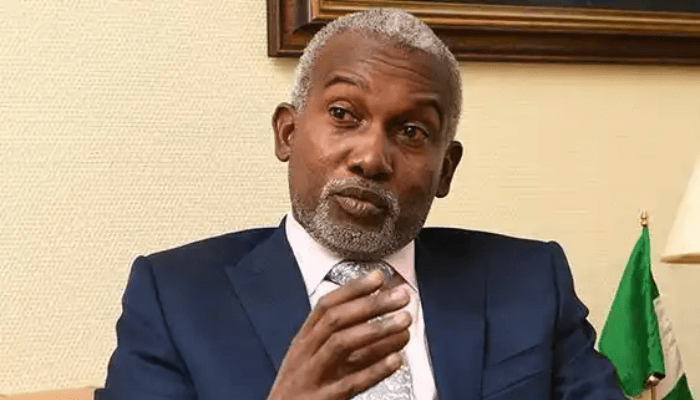
Nigeria’s Minister of Foreign Affairs, Ambassador Yusuf Maitama Tuggar, has linked the controversial US visa restrictions on Nigerian travellers to Ni
Nigeria’s Minister of Foreign Affairs, Ambassador Yusuf Maitama Tuggar, has linked the controversial US visa restrictions on Nigerian travellers to Nigeria’s refusal to accept Venezuelan prisoners into the country as demanded by the United States amid US President, Donald Trump’s crackdown on undocumented migrants.
Tuggar while speaking on the vexed issue said, “The US is mounting considerable pressure on African countries to accept Venezuelans to be deported from the US, some straight out of prisons. It will be difficult for Nigeria to accept Venezuelan prisoners into Nigeria. We have enough problems of our own; we cannot accept Venezuelan deportees to Nigeria. We already have 230 million people.”
The minister dismissed claims that the US action was a reciprocal measure against an earlier decision by Nigeria to impose a 90-day visa policy on US citizens travelling to Nigeria, stressing that Nigeria only introduced the policy for ease of operations.
He said, “We introduced an online electronic visa to save time instead of arriving before processing the visa. The online makes it easier. Our visa is not saying that every American is given only 90 days. We give more than three-year visa.”
Also, President Bola Tinubu joined other world leaders to attend the BRICS Summit in Rio de Janeiro, Brazil, from July 6 to 7, 2025.
On the final day of the summit held by the 11-member economic and political force with Chinese influence, Trump announced his decision to hit anti-American BRICS nations – including China, India and Nigeria – with an extra 10 per cent trade tariff.
Nigeria’s foreign affairs minister said the tariff hike threat might not have to do with Nigeria’s participation in the BRICS summit.
Tuggar said, “The issue of tariffs may not necessarily have to do with us participating in the BRICS meeting.”
In January 2025, Nigeria accepted an invitation to join BRICS+ as a partner country.
BRICS, an acronym for Brazil, Russia, India, China, and South Africa, was created in 2006 as a bloc that brings together the world’s most developing economies to challenge the political and economic power of the wealthier nations of North America and Western Europe.
The bloc, now known as BRICS+, later admitted new members including Egypt, Ethiopia, Indonesia, Iran and the United Arab Emirates.
BRICS+ accounts for about 37per cent of the world’s GDP. The bloc’s members account for about half the world’s population and 40 percent of global economic output.
