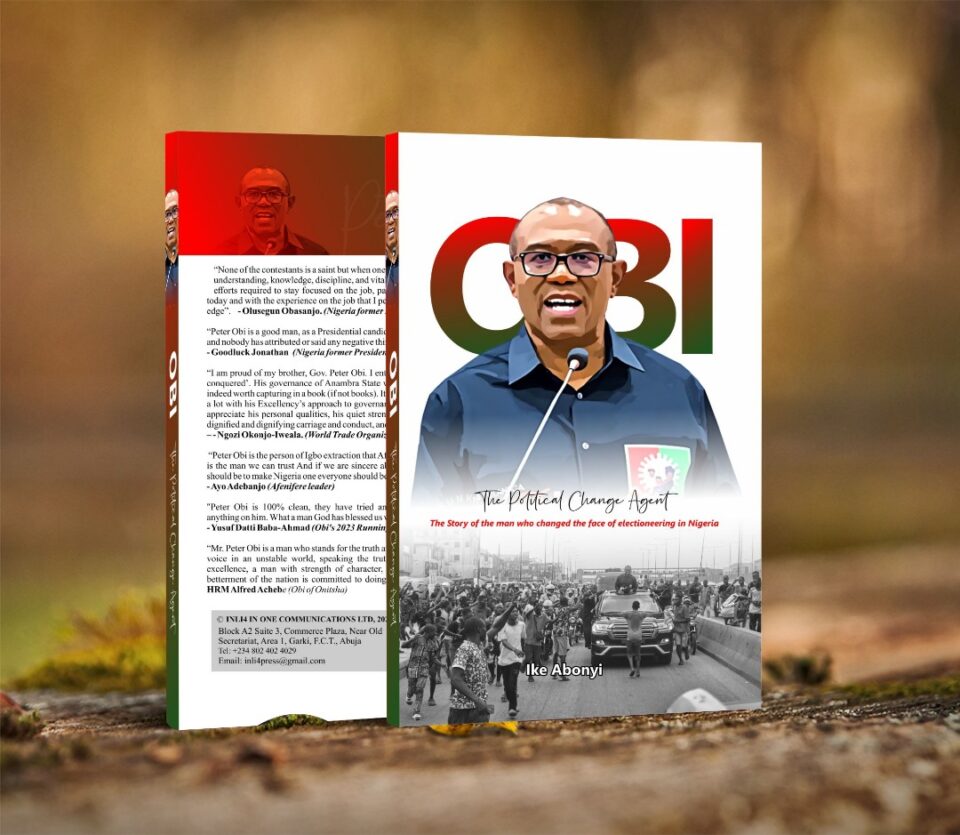
Obi: The Political Change Agent, a book by Ike Abonyi chronicles the political journey of Peter Obi, a figure who has become a voice for change in Nig
Obi: The Political Change Agent, a book by Ike Abonyi chronicles the political journey of Peter Obi, a figure who has become a voice for change in Nigeria’s democratic landscape.
The book which is the story of the man who changed the face of electioneering in Nigeria, is yet another brick in the wall of a fast-growing historical record on Peter Obi’s brand of politics.
Authored by Ike Abonyi, it explores Obi’s public service and the larger themes of accountability, simplicity, and principle-driven leadership.
The 250-page book is divided into 26 chapters, taking readers on a journey through Obi’s political career and the Obidient Movement, which has become a symbol of youth political awakening and civic courage.
As the book’s title suggests, Peter Obi is by every adjectival qualification, a political change agent in Nigerian politics. He is also an adroit competitor, in a marathon race that is far from over.
So this literary work is about Peter Obi; but in the context of Nigeria, it is about the unheralded rise of Obidient Movement phenomenon between 2022 and now. It is also about an unfinished business of nation-building, and renewal, and ultimately, a preface to the inevitability of a New Nigeria.
The core value and potency of this book, is that is written from an insider’s perspective. The book, Obi: the Political Change Agent consists of 252-pages, and twenty-six stand-alone compact chapters. Each chapter, adapted from original real-time op-eds and essays, details Peter Obi’s odyssey from the juncture when he ventured into Nigeria’s political setting, through his uncharted trajectory to becoming the Labour Party 2023 presidential candidate on 30th May, 2022 and thereafter.
Chapter 1 is essentially a backdrop, and the condensed story of Nigeria’s return to participatory democracy, from 1999 to date.
Chapter 2, x-rays the man Peter Obi, and captures his essence and bonafides via his abridged official biography.
Chapter 3 is revelatory. It documents that fortuitous but life-changing encounter that took Obi into politics. It narrates how Peter Obi’s encounter with Professor Donald Jacob, the Dean of the Kellogg School of Management in the USA, altered his views on politics. Ultimately, the unforeseen outcome of that six-week executive course was his decision to go into politics. It’s a thought-provoking story.
Chapters 4 and 5 encapsulate the Ojukwu and APGA factors; as well the Anambra governance revolution. Obi’s and sojourn in Anambra was not without its vagaries, but would have been utterly impossible without the overwhelming influence of the iconic Igbo leader, Chukwuemeka Odumegwu-Ojukwu, who was the leader of the All Progressives Grand Alliance (APGA).
Chapter 6 and 7 surveys Obi’s Journey to the center and Obi’s political dalliance with the PDP. This chapter speaks to Obi’s political movement from the state to the federal level after his successful tenure as Governor of Anambra State. The narration segues into the political leap that made him the running mate to Atiku Abubakar in the 2019 presidential election.
Chapter 8 and 9 is a periscope of how Obi’s 2023 Presidential Journey begins and landed him in the Labour Party. It chronicles Obi’s encounter with the vicissitudes of Nigeria’s rotational national politics, unkept promises and his eventual divorce from PDP. The factors at play were mot mere imponderables as much as they were a manifestation of human foibles, political machinations and shortsightedness.
Chapter 10 is about the birthing of the Obidient Movement. The chapter chronicles the emergence of the Obidient Movement in the nation’s political trajectory and how it impacted greatly on the polity during the 2023 electioneering.
Chapter 11 narrate the already well-documented 2023 election intrigues by the INEC and the ultimate Judiciary ambush. This is one of the longest chapters in the book for obvious reasons; it captured all the election intrigues, the preparations from voter registration to election proper and the post-election drama.
Chapter 12 is about ‘The Media and the Obi’s Politics.’ This chapter captures media involvement in Obi’s Presidential ambition and how the social and mainstream media played some significant roles in Obi’s politics. Some believed that Obi was a media hype that would fade away with time. They were wrong.
Chapter 13, narrate the well-known folktale of Peter Obi’s “Madman” friend, affirming ultimately, that ‘all politics is local’. During his Presidential campaigns, Peter Obi frequently recalled how in his quest for adaptive leadership, he opened himself to learning from everybody. In that context, he often recalled how during his tenure as Governor of Anambra State, he got one of the best advices that helped him tackle very naughty security issues from a “madman.” The author corroborates the seemingly bizarre story, by seeking and finding the “madman.”
Chapter 14 captioned ‘Anatomizing The Peter Obi Character’ offers an insight into varying perceptions of Peter Obi’s persona; Such perceptions are mixed and complex. Some people saw Obi is a stingy and difficult man to deal with, but to others, he is the prudent man, who detests corruption and extravagant living. To some, he was a quiet philanthropist. This chapter looks at his personality from these contrasting and eclectic perspectives.
Chapter 15 is the author’s published rendition of Obi’s experience during his brief sojourn in PDP. He facetiously asked: “Obi in PDP; was a Celibate in the Whorehouse?” He surmised how Obi’s clean character and credentials meant nothing to some of the PDP leaders who were bent on frustrating him. This narration validates Obi’s frequently uttered contention that any foray into Nigerian politics was an entanglement with “pimps and prostitutes, not priests and nuns.”
Chapter 16 and 17 titled ‘A Political Phenomenon Called Peter Obi,” is also another published op-ed by the author capturing the enigma in Peter Obi’s politics. The chapter segues to an analysis of ‘LP’s Obi and the Involuntary Campaigners.’ This article talks about how Obi campaigners emerged involuntarily after hearing his disarming messages on how to create a new Nigeria, with his “Go and verify” and “consumption to production” and “a New Nigeria is Possible” Mantras.
Chapter 18 & 19 are respectively titled “How Obi-phobics Chased the Wind” and “As Campaigns Flag off, it’s Obi…kererenke.” These chapter mirrors and juxtaposes the twin developments of dislike and, like, hate and love, ignominy and fervor Obi candidacy elicited nationally. It synoptically captures the futility of the quest by Obi’s political traducers, who embarked on a massive search for something negative about him, but failed woefully. On the flip side was the fervent mob like national support during the same period as Obi’s campaign flagged off, to endless chants of ‘Obi…kererenke’. Rather than the unfolding of scandals, that zeal would eventually transform into the electrifying campaign mood that was replete with various campaign songs and slogans that dominated the political space.
Chapter 20: captioned “OBI’s quest for Justice and Repetition of History,” recalls how Obi has always been treated unjustly since he entered politics and how he has continued to seek Justice undauntedly via legal redress.
Chapter 21 tackles the very sensitive issue of ethnified politics and the costs and challenges of being Igbo impacted Obi’s and candidacy. It further explores how that negative narrative was used derogatorily to douse Obi’s potentials.
Chapter 22 highlights the use of political trolling and fake news to demarket Obi. One such instance was the allegation that as governor, “Obi demolished Mosques.” This chapter captures endless calumny, some blatantly religious against Peter Obi during the campaigns. But as it turned out he actually built a mosque and had fantastic relationships with Muslims in his state during and after leaving office.
Chapter 23 captioned “Peter Obi, the Opposition’s Talking Drum,” documents Obi’s involuntary post-election role after being manipulated out of the presidency in the 2023 polls. The intention, as the author averred was to frustrate Obi and force him to quit the political stage. Instead, Obi chose to keep playing a proactive role from the opposition desk, becoming as it were the opposition’s vanguard. It was not to be an easy task; but Obi has remained undaunted.
Chapter 24 is captioned “Can the Labour Party Go Far Without the Obidients?” The chapter grapples with the evidential hesitance of the Labour Party leadership to fully embrace the efforts of the Obidients Movement by bringing its structure in its fold. It wonders what will become of the Labour Party without the Obidient Movement and Peter Obi and his numerous supporters. The answer as the famous song says: ‘Is blowing in the wind.”
Chapter 25 is titled “In Whose Interest Is Soyinka’s Obidient-Phobia?” Nigeria’s literature icon, Nobel laureate Professor Wole Soyinka, known for his progressive position on issues, has strangely been at the forefront in the campaign against Peter Obi and the Obidients. This chapter examines what may have caused his shocking position and volte face.
Chapter 26: “Obi on Marble” is a glossary of some of the many quotable quotes of Peter Obi. Most of these became the political refrain for his legion of followers. Their inclusion aligns well with historical records, for which the book is meat to amplify.
‘Obi: The Political Change Agent’ the story of the man who changed the face of electioneering in Nigeria, is politically enriching as it captures the historical background of our democratic struggle and offers various insightful perspectives on the different administrations since 1999.
Written in very easy-to-read prose and elegant language, it is for anyone who desires to know more about Nigeria’s uninterrupted two and half decades of the democratic journey. It offers unvarnished insight into how the issues-driven campaign messages by Peter Obi helped to revolutionize and compel Nigerian youths to discover themselves and prepare for the inevitable and proactive role they must play in nation-building.
For Nigerian youths, Peter Obi’s “take back your country” was not just a slogan, it was a clarion call that resonates till this day.
Political campaign books are usually about train wrecks and triumphs. Most are about introspection and retrospective reconstructing of issues that mattered or played out.
Obi: The Political Change Agent is none of these. It is straightforward recording of events as they happened.
Besides the protagonist, the book does not hap on the role of other key campaign dramatis persona. It does not for instance delve deeply into how the choice of Labour Party over the Social Democratic Party was made, or how the Vice-Presidential Candidate was selected over the other possible and probable candidates.
