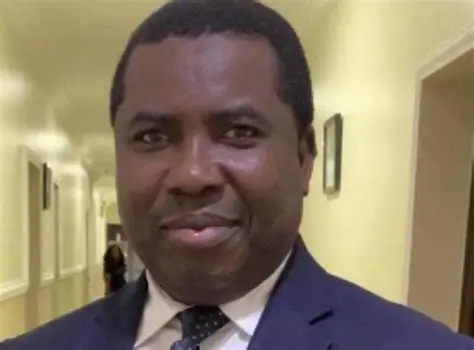
The federal government has remained silent on a 2020 legal brief reportedly written by the chairman of the Independent National Electoral Commission (
The federal government has remained silent on a 2020 legal brief reportedly written by the chairman of the Independent National Electoral Commission (INEC), Prof. Joash Amupitan, in which he described the Boko Haram insurgency and attacks by “Fulani herdsmen” as part of a coordinated anti-Christian campaign that warranted international intervention.
Amupitan was sworn in as INEC chairman by President Bola Ahmed Tinubu on October 23 following his confirmation by the Senate.
He was listed among the contributors to a publication titled ‘Nigeria’s Silent Slaughter: Genocide in Nigeria and the Implications for the International Community’, released in 2020 by the International Committee on Nigeria (ICON) and the International Organisation on Peace-building & Social Justice (PSJ).
The report chronicled alleged systematic killings of Christians in Nigeria and called for international intervention. Amupitan’s 80-page chapter was titled ‘Legal Brief: Genocide in Nigeria.’
The federal government had, last week, dismissed similar allegations after American President Donald Trump re-designated Nigeria as a Country of Particular Concern (CPC) and threatened military action; a move tied to Christian genocide.
Nigerian authorities had maintained that the security crisis affected all religious groups and was not targeted at Christians.
Amupitan’s 2020 position, which contrasts sharply with the government’s long-standing stance, has prompted a call by the Supreme Council for Sharia in Nigeria (SCSN) for his removal.
In the paper, Amupitan, who was then a faculty member at the University of Jos, Plateau State, said, among other things, that “it is a notorious fact that there is perpetration of crimes under international law in Nigeria, particularly crimes against humanity, war crimes and genocide. One word that the Nigerian authorities and international investigators and rapporteurs have not mentioned (or simply refuse to mention) in respect of the protracted violence in Nigeria is ‘genocide.’ Is this a deliberate omission or an oversight?”
He added that the “alleged involvement of the state and non-state actors in the commission of crimes under international law in Nigeria has complicated an already complex situation. Consequently, the situation beckons the urgent need for a neutral and impartial third-party intervention, especially the UN and its key organs, the military and economic superpowers, and regional or sub-regional international organisations of intergovernmental character.
“In a globalised world, international law serves as a binding cord; state sovereignty diminishes to accommodate the common interests of the global community concretised by a mixture of consent, consensus and compelling norms.”
He added that “Boko Haram sect is a desire for the Islamisation of Nigeria. The Fulani ethnic militants, on their part, have engaged in the same anti-Christian violence as their Boko Haram counterparts.
“Since it is the agenda of the Fulani to Islamise the whole of Nigeria, they have used the machinery of the State, deliberately handed over to them by the colonialists, to advance their course at all times. The period of the military regime was used maximally to create states and LGAs, and set boundaries, in a manner that gives economic and political advantages to the Hausa-Fulani ethnic group. The military regime ensured that major strategic appointments went to the Hausa-Fulani group, while their promotions in the public service, especially in the military, police, and customs, were accelerated.
“The well-orchestrated plan paid off for them because the other ethnic groups did not realise their agenda to Islamise the whole of Nigeria, and by the time the plan was being understood by some, though not all, of the other ethnic groups, the damage had already become too much. The military, police, customs, and the public service as a whole have been taken over completely, with Islamic fundamentalists planted in strategic positions to supervise the final phase of the agenda.”
In his legal brief, Amupitan had advised that the U.S. Department of State refer the case to the Criminal Division of the Department of Justice.
He had also called on the United Nations Security Council, its relevant organs, and major world powers to, among other recommendations, urge contracting parties to the Genocide Convention to sue Nigeria before the International Court of Justice (ICJ) for failing to prevent and punish genocide as required under Articles 8 and 9 of the Convention; and consider military intervention by the UN, the African Union (AU) or ECOWAS forces as a last resort, in line with Article 42 of the UN Charter.
However, the Supreme Council for Shari’ah in Nigeria (SCSN) has urged Tinubu to review Amupitan’s appointment.
In a statement by Nafiu Baba-Ahmad, its Secretary-General, the council expressed “serious concern” over the document, describing it as a “toxic legal brief containing highly provocative, distorted, and bigoted assertions about the nature of conflicts in Northern Nigeria and maligning the historical legacy of Sheikh Uthman bn Fodio’s jihad.”
The SCSN said it was “unfortunate and disturbing” that someone now responsible for safeguarding Nigeria’s democratic integrity could have once promoted such divisive and sectarian views.
“If indeed Prof Amupitan authored the said document, his submissions are not only unbecoming of a person of learning but dangerously inimical to the unity, peace, and stability of our country,” the council said.
It described as false and misleading Amupitan’s alleged analysis of “Christian genocide” and his characterisation of northern violence as an extension of the 19th-century jihad led by Sheikh Uthman bn Fodio.
“Nothing could be further from the truth,” the statement said. “If we set aside the emotive distortions and examine the facts objectively, the reality is that the violence in Northern Nigeria is complex and multi-dimensional. Both Muslims and Christians have suffered immensely from violent extremists, banditry, and communal conflicts rooted in neglect, poverty, and social injustice.”
The council cited humanitarian data showing that Muslims have suffered more casualties in the affected areas, adding that it “defies logic and decorum to reduce these tragedies to a one-sided narrative of Christian persecution.”
It also faulted attempts to link the region’s current insecurity with the jihad of Sheikh Uthman bn Fodio, describing such claims as “a malicious distortion of history and a deliberate misrepresentation of one of West Africa’s most revered reform movements.”
“The jihad of Sheikh Uthman was not a war of hatred or extermination but a spiritual, moral, and social reform movement aimed at restoring justice, knowledge, and good governance,” the council added.
The SCSN argued that the position of INEC chairman demands the highest standards of neutrality, fairness, and inclusivity, qualities it said were inconsistent with the sentiments expressed in the alleged brief.
“Prof Amupitan has demonstrated, through the content of that document, a deep-seated prejudice that calls into serious question his capacity to conduct free and fair elections in a multi-religious, multi-ethnic nation,” it said.
The council further expressed concern that such a person could have passed through security clearance and vetting before being appointed to such a sensitive position, describing it as “either a grave lapse in due diligence or a reckless approval that undermines public trust in the system.”
It, therefore, called on President Tinubu to “critically review the appointment of Prof Amupitan as INEC chairman to safeguard the credibility of the nation’s electoral process.”
“The integrity of Nigeria’s elections cannot be entrusted to someone whose record reveals open hostility toward one of the country’s largest faith communities,” the statement added.
While reiterating its commitment to peace and unity, the SCSN urged Nigerians, both Muslims and Christians, to reject divisive narratives and focus instead on confronting common challenges such as injustice, corruption, poverty, and insecurity.
